Showing posts with label civil work. Show all posts
Showing posts with label civil work. Show all posts
Friday, 16 May 2014


Thursday, 15 May 2014
How to repair the cracked concrete structures yourself

concrete crack injection using epoxy resin
Crack injection repair to concrete structures
Scope of work:
Injection of dead cracks with low viscosity 2 components epoxy resin in order to repair the concrete structures.
PREPARATION FOR INJECTION WORK
14mm holes must be drilled along the crack path between 200 – 300 mm centres. The holes must be deep enough to receive the ‘metal pipe sleeves’ (approx. 20mm)
Insert Sika ‘metal pipe sleeves’ into all the holes and epoxy into position using Sikadur 731
Clean the concrete surface adjacent to the crack with a wire brush or sandpaper.
Wipe down the concrete with a clean rag to remove any dust and loosely adhering particles.
The cleaned surface is then sealed using Sikadur 731 applied by a spatula or trowel.
CRACK INJECTION
Following the curing of the Sikadur 731 (minimum of 12 hours at 30oC) the epoxy injection can commence.
Starting from one side or the lowest point of the crack a Sika ‘nipple’ is screwed into the first pipe sleeve and Sikadur 752 injected into the crack until the epoxy is seen to ooze from the adjacent pipe sleeve, this pipe sleeve is then sealed with a nipple, continue to inject the current port until refusal (epoxy resin can not be injected more) and then start the injection of the adjacent port and so on. This procedure is continued in the sequence indicated until all have been completed.
Beginning at the first nipple filled, the nipple is removed and checked for incomplete filling. If any of the pipe sleeves are found to be incompletely filled, the injection of Sikadur 752 must recommence from the previous pipe sleeve to the one found incomplete until full and the nipple replaced. This checking process is continued (without interruption) along the crack until all have been checked.
After a curing time of 12 hours the sleeve and nipples are trimmed off with an angle grinder or other suitable equipment.
The Earthquake-Proof Building That Is Built to Collapse
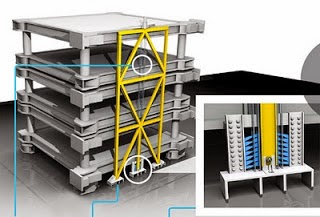
"Elastic high-strength steel cables run down the center of the system’s frame. The cables control the rocking of the building and, when the earthquake is over, pull it back into proper alignment."
"A steel frame situated around a building’s core or along exterior walls offers structural support. The frame’s columns, however, are free to rock up and down within steel shoes secured at the base."
"Steel fuses (in blue) at the frame’s center twist and contort to absorb seismic energy. Like electrical fuses, when they “blow out” they can be replaced, restoring the structural system to pre-earthquake conditions."
For decades, the goal of seismic engineers has seemed straightforward: Prevent building collapse. And so they add steel braces to a skyscraper’s skeleton or beefier rebar to concrete shear walls. After absorbing the brunt of seismic shaking, however, the compromised structures often must be demolished. “The building, in a sense, sacrifices itself to save the occupants,” says Gregory Deierlein, a Stanford University civil and environmental engineer. A team Deierlein led with Jerry Hajjar, a Northeastern University engineer, hopes to change that, designing a system that protects both people and the structures they live and work in.
Last fall, the engineers successfully tested a 26-foot-tall, three-story, steel-frame building outfitted with the new system, built atop the E-Defense shake table—the world’s largest earthquake simulator—in Miki City, Japan. Steel “fuses,” not structural elements, absorbed the shock of an earthquake greater than magnitude 7, and cables pulled the building back into plumb once the shaking stopped. After an earthquake of that scale, the deformed fuses could be replaced in about four days—while the building remained occupied. Jim Malley of the San Francisco firm Degenkolb Engineers calls the system the next step in the evolution of green building. “As structural engineers,” he says, “our sustainable design is the ability not to have to tear buildings down after earthquakes, but to use them for hundreds of years.”
Monday, 12 May 2014
Requirements for transportation of Concrete

The contents of the mixer shall be discharged in one continuous operation and the concrete transported in such a manner that there shall be no segregation of its constituents. If, in the opinion of the Engineer, any segregation of the concrete materials has taken place during transport, the concrete shall be again turned over and mixed just before it is finally placed in position. No water shall be added to the concrete between the time of mixing and placing except on the written instructions of the Engineer.
Whilst being transported from the mixer to the site of placing, all concrete shall be properly protected from contamination by dust or sand and from excessive moisture gain or loss from rainfall or high temperature, and all equipment used shall be purpose-made for the correct transportation of concrete.
Each batch of concrete delivered to the Site shall be accompanied by a delivery ticket, a copy of which shall be handed to the Engineer’s representative at the time the delivery is made. The following minimum information shall be printed, stamped or written on the delivery ticket:
Name or number of ready-mixed concrete depot:
Serial number of ticket
Date
Truck number
Name of location of site
Grade or mix description of concrete, including minimum cement content.
Specified workability
Type of cement
Nominal maximum size of aggregate
Type or name of admixture, if included, and the dosage quantity
Quantity of concrete in cubic meters
Time of loading, defined as the time of contract between cement and aggregates or when these are surface dry, between cement and added water.
The contractor shall complete the following items of information on the delivery ticket after the discharge of each batch of concrete:
Arrival and departure times of the truck
Time of completion of discharge
Details of extra water or any other materials added on site
Position in the Works where concrete is placed
In the case of truck mixed concrete, the water may be added either at the concrete supplier’s plant or under the Contractor’s supervision after arrival at Site, but not in transit. Transporting the concrete mixture manually is only applied for the distance not over 200m. If the concrete mixture is segregated, need to re-mix before filled into formworks. When using the hung containers to transport the concrete mixture, the concrete mixture poured into the hung containers is not exceed 90 – 96% of the container volume.
Transporting the concrete mixture by truck or specific vehicle, need to ensure for the following requirements:
The thickness of the concrete layer in the truck body need to be greater than 40 cm if using self-dump truck;
If using specialized vehicle, both in transportation and mix, the transportation technology is determined by technical parameters of using equipment.
When using concrete pump for transportation, need to ensure for the following requirements:
The components and slump of concrete need to be tested and trial pumped in order to ensure for the concrete quality and constructing condition, concurrently, suitable for technical function of pump equipment.
When constructing in the hot conditions, the exterior surface of pipe need to covered or white painted in order to limit the radiation from the sun to heat the concrete.
Subscribe to:
Posts (Atom)